
- All
- Product Name
- Product Keyword
- Product Model
- Product Summary
- Product Description
- Multi Field Search
Views: 0 Author: Site Editor Publish Time: 2026-01-28 Origin: Site


Every warehouse manager faces the same pivotal decision eventually. You have goods to move, deadlines to meet, and a budget to balance. The efficiency of your material handling operations often hinges on a single choice: should you stick with the trusty, low-cost manual options, or invest in the speed and power of an electric model?
Choosing between an Electric Pallet Truck and a manual pallet truck isn't just about price tags. It's about understanding your workflow, the physical toll on your employees, and the long-term productivity of your facility. A mismatched piece of equipment can lead to bottlenecks, increased injury rates, and wasted time. Conversely, the right choice can streamline your entire supply chain.
In this guide, we will break down the mechanics, benefits, and drawbacks of both options. We will help you navigate the specifications and operational needs to determine exactly which lifting solution belongs on your warehouse floor.
A manual pallet truck, often referred to as a pallet jack, is the standard workhorse of the logistics industry. It relies entirely on human effort and simple mechanics. The core of this machine is Hydraulic Pallet Equipment. The operator pumps the handle to activate the hydraulic lifting mechanism, raising the forks off the ground, and then pulls or pushes the load to its destination.
These trucks are ideal for smaller warehouses, retail backrooms, or loading docks where pallet movement is infrequent. If your operation involves moving light loads over short distances—typically less than 40 feet—a manual truck is often sufficient. They are also the go-to choice for tight spaces, like inside the back of a delivery lorry, where maneuverability is key.
Pros:
Cost-effective: The initial purchase price is significantly lower than electric alternatives.
Low maintenance: With fewer moving parts and no electrical components, repairs are simple and infrequent.
No charging required: They are always ready to go; you never have to worry about downtime due to a dead battery.
Durability: Their robust, mechanical design can withstand rough handling.
Cons:
Physical strain: The operator provides 100% of the force to move and stop the load, which can lead to fatigue or injury.
Limited weight capacity: Moving very heavy loads (over 2000kg) manually is extremely difficult and dangerous.
Slower operations: Moving goods takes longer, reducing overall throughput in high-volume settings.
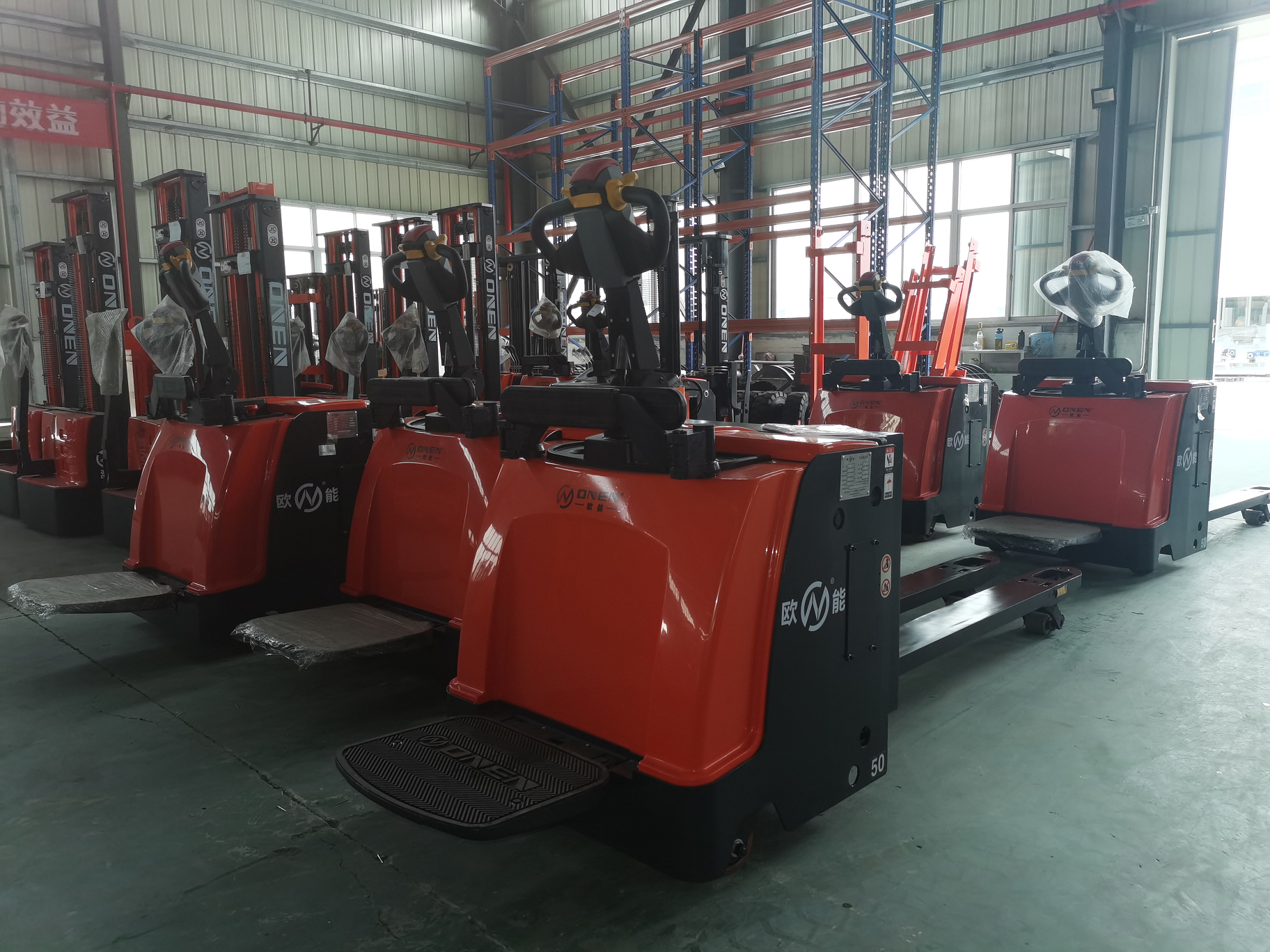
An Electric Pallet Truck takes the physical labor out of the equation. These units utilize a battery-powered electric motor to drive the wheels and a powered hydraulic pump to lift the forks. The operator steers the unit, but the heavy lifting and moving are handled by the machine.
The primary advantage here is speed and endurance. An electric truck allows an operator to move heavier loads faster and over longer distances without breaking a sweat. For facilities with long aisles or large floor plans, the ability to effortlessly transport goods from one end of the warehouse to the other is a game-changer.
Companies like ONEN Forklifts have refined this technology, adopting European design styles and imported AC control systems to ensure these trucks are not just powerful, but also safe and precise.
Pros:
High productivity: Loads are moved faster, increasing the number of pallets handled per hour.
Reduced fatigue: The motor does the work, protecting workers from repetitive strain injuries and exhaustion.
Safety features: Modern units often come with braking systems and speed controls to prevent accidents.
Higher capacity: They can easily handle heavier pallets that would be impossible to move manually.
Cons:
Higher upfront cost: The technology and battery systems make these units more expensive to purchase.
Maintenance: They require regular battery maintenance and checks on electrical components.
Charging time: You need to manage charging schedules or swap batteries to ensure continuous operation.
1
To make an informed decision, it helps to see the differences side-by-side. Below is a comparison of key factors that usually influence the purchasing decision.
Feature | Manual Pallet Truck | Electric Pallet Truck |
|---|---|---|
Power Source | Human effort (Hydraulic) | Battery (Electric Motor) |
Travel Speed | Slow (Walking pace) | Fast (Motorized) |
Physical Effort | High | Low |
Maintenance Cost | Low | Medium |
Initial Investment | Low | High |
Best for Distance | Short distances | Long distances |
Injury Risk | Higher (Strain/Fatigue) | Lower (Ergonomic) |
While the manual option wins on the initial receipt, the Electric Pallet Truck often wins on ROI for busy facilities. If an employee takes 10 minutes to move a pallet manually but only 3 minutes with an electric truck, the labor savings add up rapidly. Over a year, the electric truck pays for itself in reclaimed man-hours and reduced injury leave.
However, if your truck sits idle for 90% of the day, the manual option offers better value because you aren't tying up capital in equipment you don't use.

Selecting between Hydraulic Pallet Equipment and electric motors requires an audit of your specific environment. Ask yourself the following questions to guide your selection.
If your employees are walking hundreds of feet per trip, a manual truck will slow them down significantly. For warehouses larger than a standard retail stockroom, electric assist is usually necessary to maintain efficiency.
If you are constantly moving pallets weighing over 1500kg, relying on manual force is a liability. It risks injury to staff and damage to goods if control is lost. Electric trucks are designed to handle these weights safely.
Are you capital-rich but labor-constrained? If so, electric trucks maximize the output of the staff you have. If you are a startup with limited capital and low volume, starting with manual trucks is a sensible, low-risk way to begin.
For continuous use throughout an 8-hour shift, electric is the only humane and efficient option. For occasional use—perhaps receiving one shipment a week—a manual truck is perfectly adequate.
When upgrading your fleet, quality matters. ONEN Forklifts has been a professional manufacturer since 1998, bringing over 30 years of experience to the table. Whether you need a simple manual solution or a high-tech electric unit, reliability is non-negotiable.
ONEN distinguishes itself by adopting a European Italian design style, ensuring that even their heavy-duty machinery has a compact body and low noise output. Their electric trucks feature high-strength structural parts and powerful motor configurations, designed to be safe, durable, and energy-saving.
When you choose ONEN, you aren't just buying a tool; you are investing in a low-maintenance solution that prioritizes environmental protection and operator safety. From self-propelled scissor lifts to efficient pallet stackers, their range covers every aspect of warehouse logistics.
The battle between manual and electric isn't about which is "better" in the abstract—it is about which is better for you. If speed, safety, and high-volume throughput are your goals, an Electric Pallet Truck is the clear winner. If simplicity, low cost, and occasional use define your needs, the manual pallet truck remains the champion.
Assess your needs, consider your budget, and choose the tool that keeps your business moving forward.
For more information on high-quality material handling solutions, visit ONEN Forklifts.


